Certified Diamond Supplier in Delhi
Blog

Certified Diamond Supplier in Delhi – Best Prices 2026

Delhi’s diamond market is crowded. Walk through Karol Bagh, South Extension, or Chandni Chowk and you will find hundreds of shops claiming to sell certified diamonds. But not every certificate carries the same weight, and not every supplier can explain why a stone is priced the way it is. If you are searching for a certified diamond supplier in Delhi, the real question isn’t just “where can I buy a diamond” it’s who can prove, scientifically and independently, that the diamond I’m buying is exactly what they say it is. This guide breaks down everything you need to know before buying a certified diamond in Delhi in 2026 how certification works, which labs matter, what actually affects diamond pricing, and why the Indian Institute of Gemology (IIG) has become one of the city’s most trusted names for certified diamonds, diamond grading, and gemological education. Why Diamond Certification Matters More Than Ever in 2026 A diamond certificate also called a grading report is issued by an independent gemological laboratory after the stone has been examined under controlled lighting and magnification by trained gemologists. It records the diamond’s exact measurements, weight, and quality grade across the 4Cs Cut, Clarity, Colour, and Carat. Without certification, you are relying entirely on a seller’s word. With certification, you have an independent, third-party document that: In 2026, with lab-grown diamonds now widely available at a fraction of natural diamond rates, certification has become even more important. Two diamonds can look identical to the naked eye and have completely different origins and values. A proper grading report is the only way to know for certain what you are actually paying for. The 4Cs: What Every Certificate Actually Measures Factor What It Measures Why It Matters Carat The physical weight of the diamond (1 carat = 200mg) Larger carat weight generally means higher value, but only when paired with good cut, colour, and clarity Cut How well the diamond’s facets interact with light A well-cut diamond reflects more light and appears brighter, regardless of size Colour Graded from D (colourless) to Z (light yellow/brown) Colourless diamonds are rarer and more valuable Clarity Presence of internal inclusions or external blemishes Fewer inclusions mean a cleaner, more valuable stone Understanding these four factors helps you read any certificate confidently whether it comes from IIG, GIA, IGI, or any other recognised laboratory. Indian Institute of Gemology: Delhi’s Trusted Certified Diamond Supplier The Indian Institute of Gemology (IIG) has been a respected name in Delhi NCR’s gem and jewellery industry for decades, combining hands-on gemological expertise with a genuine commitment to consumer trust. Founded and led by Mr. Gurmit Singh, a well-known gemologist and educator, IIG operates as both a certified diamond supplier and one of India’s most established gemology training institutions. What sets IIG apart is simple: the people grading and supplying your diamond are the same experts who train the next generation of professional gemologists in India. This dual role as an educational authority and a practical supplier gives IIG a level of technical credibility that is difficult to match. What IIG Offers Because IIG’s gemologists personally examine every stone under controlled conditions, buyers receive a level of transparency that many high-volume commercial sellers simply cannot offer. You are not just buying a diamond you are buying the judgement of trained, experienced gemologists who stake their professional reputation on every report they issue. Which Certification Is Best for Diamonds? This is one of the most common questions diamond buyers ask, and the honest answer is: it depends on what you’re buying and why. No single certification is universally best for every situation. What matters is choosing a lab whose grading standards match your purpose whether that’s a high-value natural solitaire, an everyday piece of diamond jewellery, or a lab-grown stone. Certification Body Known For Best Suited For GIA (Gemological Institute of America) The strictest, most conservative grading standards globally High-value natural diamonds, investment-grade purchases, international resale IGI (International Gemological Institute) Widely accepted; grading is generally slightly more lenient than GIA; dominant in lab-grown diamond certification Lab-grown diamonds, everyday fine jewellery, retail purchases SGL (Solitaire Gemological Laboratories) Regional recognition across India and South Asia; faster turnaround Budget-conscious buyers, smaller stones, regional resale IIG (Indian Institute of Gemology), Delhi Locally trusted, hands-on gemological expertise, backed by an established gemology training institute Buyers in Delhi NCR who want direct expert consultation, transparent grading, and a supplier they can meet, question, and verify in person The key takeaway: for buyers in Delhi who want a certification process they can personally verify meeting the gemologists, understanding the grading rationale, and getting guidance tailored to their budget. IIG offers a level of accessibility and personal trust that larger, faceless global labs cannot replicate locally. Which Is Better – IIG Delhi or SGL? This is a frequent point of comparison for Delhi-based buyers, since both are regionally recognised and commonly seen on diamonds sold across North India. Here’s an honest, side-by-side look. Comparison Point Indian Institute of Gemology (IIG) SGL (Solitaire Gemological Laboratories) Local presence in Delhi NCR Established, direct, in-person consultation available Present but primarily lab-focused Educational backing Runs recognised gemology and diamond grading courses, meaning graders are formally trained and continuously assessed Primarily a grading and certification service Transparency with buyers Buyers can consult directly with gemologists and understand grading decisions Reports are issued but direct buyer interaction with graders is limited Turnaround time Efficient, with personalised service for individual buyers Known for fast turnaround, especially for bulk trade orders Best suited for Individual buyers, jewellers, and businesses in Delhi NCR wanting a trusted local relationship alongside certification Traders and businesses needing quick, high-volume certification In short: SGL is a well-known regional lab, particularly efficient for high-volume trade certification. IIG, on the other hand, combines certification with genuine gemological expertise, education, and personal accessibility making it the stronger choice for individual buyers in Delhi who want to understand exactly what they’re purchasing, ask questions directly, and build a long-term relationship with a supplier they

Certified Diamond Supplier in Delhi – Best Prices 2026 Read Post »

best gem testing lab in Delhi
Blog

Best Gem Testing Lab in Delhi 2026 – Certified & Accurate

Buying or wearing a gemstone without verifying it first is a bit like signing a contract without reading it. You may be holding a genuine, high-value stone or you may be holding a treated, synthetic, or completely fake look-alike sold at a premium. This is exactly why gem testing has moved from being a nice to have to a non-negotiable step for anyone buying, selling, inheriting, or wearing a gemstone in India today. If you are searching for the best gem testing lab in Delhi, this guide walks you through everything you need to know in 2026 how gem testing works, what separates a trustworthy lab from a questionable one, and why the Indian Institute of Gemology (IIG), founded and led by veteran gemologist Gurmeet Singh, remains one of the most respected names in Delhi-NCR’s gem and jewellery testing community. Why Gem Testing Has Become Essential in 2026 The gems and jewellery market has changed dramatically over the last decade. Lab-grown diamonds, glass-filled rubies, dyed quartz sold as emerald, and synthetic stones manufactured to mimic natural gems are now widely available and increasingly difficult to tell apart from the real thing with the naked eye. At the same time, more buyers are purchasing gemstones for astrological remedies, investment purposes, or as heirloom jewellery, which makes authenticity even more important. The Rise of Synthetic and Treated Stones Modern synthetic gemstones are manufactured with such precision that even experienced jewellers can be fooled without proper instrumentation. Heat treatment, fracture filling, dyeing, and lattice diffusion are common practices used to enhance the color and clarity of lower-grade stones before they are sold as premium natural gems. A qualified gem testing laboratory uses scientific instruments, refractometers, spectroscopes, polariscopes, and microscopes to detect these treatments, something that simply cannot be done by visual inspection alone. Astrological and Investment Value of Certified Gems In India, gemstones are widely worn for astrological reasons: a Yellow Sapphire for Jupiter, a Red Coral for Mars, an Emerald for Mercury, and so on. If the stone worn for a specific planetary remedy is not genuine, the wearer does not get the intended benefit, and money is wasted on a stone that has no real astrological or monetary value. A certified report protects both the astrological intent and the financial investment behind the purchase. Growing Consumer Awareness Today’s buyers are far more informed than they were even five years ago. They actively search for a gem testing lab near me,compare certification reports, and verify credentials online before making a purchase. This shift in consumer behavior has made certification a deciding factor in whether a sale closes or not for both retail buyers and wholesale jewellers. Delhi’s Gem & Jewellery Market: Why Testing Matters Locally Delhi and the wider NCR region have long been one of India’s busiest hubs for gems and jewellery trade, from wholesale markets to boutique jewellers to individual astrologers who recommend specific stones to their clients. This high volume of trade brings genuine expertise into the market but it also creates room for mislabeled, treated, or synthetic stones to circulate, particularly in unorganized retail settings where buyers may not think to ask for scientific verification. For residents of Delhi-NCR, having access to an experienced, locally established gem testing laboratory means authentication does not require sending a stone out of the city or waiting weeks for a report from a distant facility. It also means the lab testing your stone is familiar with the specific mix of gemstones commonly traded in the region — from astrological Navratna stones favored by North Indian buyers to diamonds and coloured stones sold through the city’s established jewellery markets. Key Benefits of Getting Your Gemstone Certified What Makes a Gem Testing Lab Trustworthy? Not every lab that claims to test gemstones follows the same standards. Before you trust a laboratory with your stone, it helps to understand the factors that separate a credible lab from one that simply prints a certificate without proper scientific analysis. Evaluation Factor What to Look For Why It Matters Experience & Legacy Decades of continuous operation in gemology Long-standing labs have tested thousands of stones and refined their identification accuracy over time Qualified Gemologists Certifications such as FGA (UK), GIA (USA), or AIGS (Thailand) Internationally recognized qualifications indicate rigorous, standardized training Laboratory Equipment Refractometer, polariscope, spectroscope, microscope, UV fluorescence unit Scientific instruments are the only reliable way to detect treatments and synthetics Report Transparency Detailed reports with photographs, plotting, and gemological data A vague, one-line certificate offers little real verification Independent & Unbiased Testing No conflict of interest between testing and selling of the same stone under review Ensures the report reflects the stone’s true nature, not a sales incentive Reputation & Track Record Testimonials, industry recognition, years of teaching or training gemologists Reflects consistent, verifiable credibility within the trade A lab that checks most or all of these boxes gives you far more confidence than one relying purely on marketing claims. Indian Institute of Gemology – Delhi-NCR’s Most Trusted Name in Gem Testing Among the many labs claiming to be the best gem testing lab in Delhi, the Indian Institute of Gemology (IIG) stands out because of its long institutional history, the depth of expertise behind it, and its dual identity as both a teaching institute and a working gem testing laboratory. This combination is rare; most labs either only test gemstones or only teach gemology. IIG does both, which means the same gemological rigor taught to its students is applied to every stone it tests. A Legacy That Began in 1991 The Indian Institute of Gemology has been active in the gems and jewellery education and testing space since 1991 with more than three decades of continuous work in the field. Over this period, IIG has trained students from across India as well as international learners from the United States, Canada, Japan, Australia, Ireland, Uganda, Kenya, Lithuania, and Russia, among other countries. This global exposure has shaped a laboratory culture that follows internationally accepted gemological

Best Gem Testing Lab in Delhi 2026 – Certified & Accurate Read Post »

Gem Identification Course
Blog

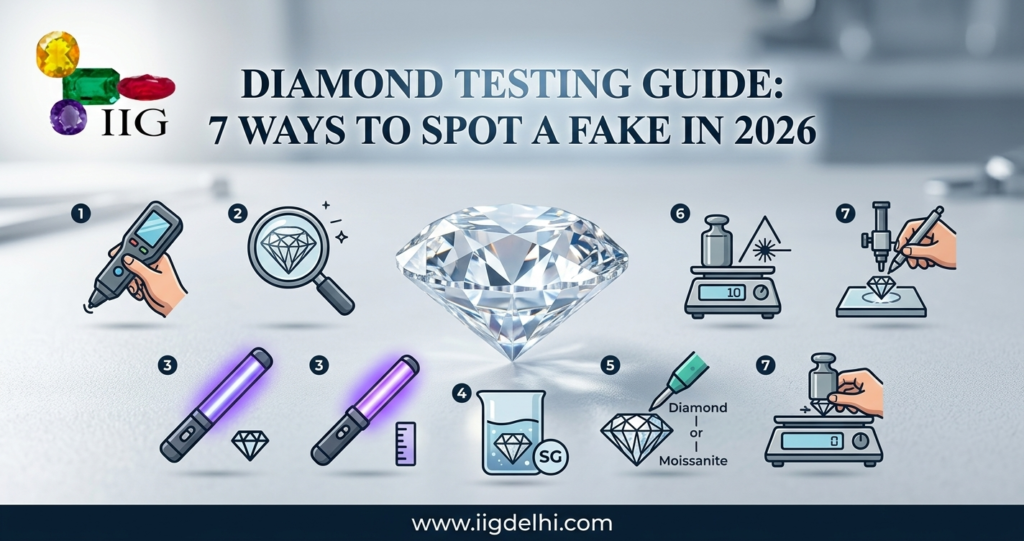
Diamond Testing Guide: 7 Ways to Spot a Fake in 2026

Diamonds have never been harder to verify by eye. Between lab-grown diamonds, high-quality moissanite, and advanced cubic zirconia, even seasoned jewelry buyers in 2026 struggle to tell a genuine stone from a convincing imitation. If you have ever held a diamond  inherited, gifted, or purchased and quietly wondered, Is this actually real?, you are not alone. This guide breaks down seven reliable ways to test a diamond, explains what each test can (and cannot) prove, and shows you why professional gemological training is the only method that removes all doubt. Whether you are a jewelry buyer, a collector, or someone exploring a career in gems, understanding these tests is the first step toward real expertise the kind taught in a structured Gem Identification Course. Why Diamond Authentication Matters More in 2026 The diamond market has changed dramatically over the last few years. Lab-grown diamonds are now common in Indian and global jewelry markets, moissanite has improved to the point where it fools basic testers, and online diamond sales have made it easier than ever to buy a stone without ever seeing it in person first. A few realities every buyer should know in 2026: This is exactly why a growing number of jewelry professionals, collectors, and small business owners in India are enrolling in a formal Gem Identification Course rather than relying on guesswork. Diamond vs. Common Fakes: Quick Comparison Table Before testing a stone, it helps to know what you might actually be dealing with. Here is how a real diamond compares to the most common substitutes found in the Indian and global jewelry market. Property Real Diamond Cubic Zirconia (CZ) Moissanite White Sapphire Hardness (Mohs Scale) 10 (hardest known mineral) 8 – 8.5 9.25 9 Thermal Conductivity Extremely high Very low High (can fool testers) Low Sparkle Type Balanced white + colored flashes Excessive rainbow flashes Very strong rainbow flashes Duller, hazier sparkle Density Higher (sinks fast in water) Heavier per size, but low density index Slightly lower than diamond Lower than diamond Facet Edges Sharp, crisp Often slightly rounded Sharp Sharp Electrical Conductivity Does not conduct Does not conduct Conducts electricity Does not conduct Common Use Fine jewelry, engagement rings Costume & imitation jewelry Diamond alternative Natural gemstone, diamond look-alike This table alone explains why a single home test is never enough – several fakes share one or two diamond-like properties, but none share all of them. 7 Ways to Spot a Fake Diamond Below are the seven most practical and widely used methods for checking a diamond’s authenticity, ranked from simplest at-home checks to professional laboratory-grade testing. 1. The Fog Test Breathe lightly on the stone, the way you would fog up a mirror. A real diamond disperses heat so quickly that the fog clears in about a second. If the stone stays foggy for several seconds, it is likely an imitation such as cubic zirconia or glass. What it actually proves: Diamonds conduct heat extremely well, so they clear fog almost instantly. This test can rule out low-grade imitations quickly, but it cannot distinguish a diamond from moissanite, since moissanite also disperses heat fast. 2. The Water Test Drop the loose stone into a glass of water. Because diamonds are dense, a genuine stone sinks immediately. Many imitations, including glass and lower-density simulants, float or sink slowly. What it actually proves: This test only works on loose (unmounted) stones and is unreliable for smaller stones or heavier simulants like large cubic zirconia, which can sink too. It is a helpful first filter, not a final answer. 3. The Sparkle and Light Reflection Test Hold the stone under a bright light or near a window and observe how it reflects light. A well-cut diamond shows a balanced mix of white brilliance and small flashes of color (called “fire”). Fakes often throw excessive, overly colorful flashes or look flat and glassy. What it actually proves: Sparkle differences are real, but they require experience to judge accurately. Without comparing the stone to a known diamond side by side, most people misjudge this test – which is one of the core skills taught hands-on in a Gem Identification Course. 4. The Loupe and Facet Test Using a jeweler’s loupe or a 10x magnifying glass, examine the stone’s facet edges and internal characteristics. Diamonds are cut by skilled professionals and typically show sharp, crisp facet edges along with natural inclusions (tiny internal marks). Molded imitations often have rounded or slightly soft edges, and flawless stones with zero inclusions are more likely fakes than natural diamonds. What it actually proves: This is one of the more reliable at-home checks, but reading a loupe correctly takes training. An untrained eye frequently misreads natural inclusions as damage, or misses telltale mold marks entirely. 5. The Setting and Mounting Check Look at how the stone is set in its jewelry piece. Genuine diamonds are usually mounted in gold, white gold, or platinum, with a hallmark stamp (14K, 18K, PT950, etc.) stamped inside the band. Cheap imitations are frequently set in gold-plated or silver-toned base metal, and the craftsmanship around the setting is often noticeably lower quality. What it actually proves: This is circumstantial evidence, not proof. High-quality fakes can still be set in real gold, so this test should always be combined with others. 6. The UV (Ultraviolet) Light Test Place the stone under a UV lamp. Many natural diamonds emit a soft blue glow, known as fluorescence, under UV light. Absence of fluorescence does not mean a stone is fake, since a large share of natural diamonds show no fluorescence at all — but the presence of unusual colors (such as green or yellow glow) can indicate a simulant. What it actually proves: This test is inconclusive on its own, since fluorescence patterns vary widely among real diamonds. It works best as a supporting test, not a standalone verdict. 7. Professional Thermal and Electrical Conductivity Testing This is the gold standard among the seven methods. A jeweler or gemologist uses a calibrated

Diamond Testing Guide: 7 Ways to Spot a Fake in 2026 Read Post »

Diamond Dealer in Gurugram
Blog

Diamond Dealer in Gurugram: Buy Direct From Source No Markup

Buying a diamond is rarely a casual purchase. It usually marks a milestone: an engagement, an anniversary, a family heirloom being passed down, or simply a long-planned investment in something that lasts. Yet for most buyers, the process feels confusing. Showroom prices vary wildly from one store to the next, certificates use unfamiliar terminology, and it’s hard to know whether the diamond in front of you is priced fairly or padded with layers of hidden margin. This is exactly why more buyers across Delhi NCR are searching for a diamond dealer in Gurugram who sources stones directly, rather than a retail showroom that has quietly marked up the price at every stage of the supply chain. Gurugram, with its concentration of corporate professionals, diplomats, and NRI families, has become one of the more active diamond markets in North India and understanding how the trade actually works is the first step to buying with confidence. This guide walks through what direct from source really means, how diamonds are priced and certified, how to evaluate a dealer, and why gemological education, not just a fancy showroom, is often the real difference between a good purchase and a regretted one. Why Gurugram Has Become a Serious Diamond Buying Market Gurugram’s growth over the last decade hasn’t just been about office towers and malls. It has quietly built a jewellery and diamond trade ecosystem that caters to a buyer base very different from traditional gold-and-diamond markets in Old Delhi or Chandni Chowk. A few reasons this shift happened: The result is a market where buyers increasingly prefer working with a diamond dealer in Gurugram who can explain sourcing, certification, and pricing clearly instead of simply pointing to a display case What Does Direct From Source, No Markup Actually Mean? The phrase gets used often, but few buyers understand the supply chain behind it. Here’s the simplified version. A diamond typically moves through several hands before it reaches a showroom shelf: Each layer adds cost, not necessarily value. A direct-from-source dealer shortens this chain by sourcing polished diamonds straight from cutting houses or established wholesale networks, cutting out one or more middlemen. This doesn’t mean diamonds are sold “at cost”  a dealer still needs a sustainable margin to operate — but it does mean the buyer isn’t paying for three or four extra markups stacked on top of each other. How the Pricing Chain Compares Stage of the Supply Chain Traditional Multi-Layer Retail Direct-From-Source Dealer Sourcing Diamond passes through multiple wholesalers/brokers Sourced closer to cutting house or primary wholesale market Number of markups added Typically 3–4 layers Typically 1-2 layers Price transparency Often bundled into final price,hard to break down Easier to itemise stone cost vs making charges Certification disclosure Sometimes optional or add-on Usually provided upfront as standard practice Negotiation room Limited, since MRP is inflated to allow “discounts” Narrower, since the starting price is already closer to fair market value This table isn’t meant to suggest that every showroom is overpriced, established retail jewellers offer real value through design expertise, after-sales service, and buyback policies. It simply explains why a direct-sourcing model can offer a more transparent starting point for buyers who already know what they’re looking for. Understanding the 4Cs Before You Buy No matter which diamond dealer in Gurugram you choose, every serious conversation about diamond value comes back to four fundamental characteristics, universally known as the 4Cs. Characteristic What It Measures Why It Matters Carat The weight of the diamond (1 carat = 200 milligrams) Larger carat weight generally increases value, but two diamonds of the same carat can look very different depending on cut Cut How well the diamond’s facets interact with light Often the most important factor for visual brilliance and sparkle — a well-cut smaller diamond can outshine a poorly cut larger one Colour Graded from D (colourless) to Z (light yellow/brown) Near-colourless diamonds (D–F) are rarer and pricier; slight tints are often invisible to the untrained eye Clarity Presence of internal inclusions or external blemishes Graded from Flawless (FL) to Included (I3); most inclusions in mid-range grades aren’t visible without magnification A dealer who takes time to explain how these four factors interact rather than only quoting a final price  is generally a more trustworthy source. Buyers who understand the 4Cs are far less likely to overpay for carat weight while sacrificing cut quality, which is one of the most common mistakes in diamond buying. Natural Diamonds vs Lab-Grown Diamonds: Which Should You Choose? Gurugram’s diamond market has seen a sharp rise in lab-grown diamond demand over the past few years, driven by cost-conscious millennial buyers and a growing conversation around sustainability. Both are chemically identical forms of crystallised carbon — the difference lies in origin, not composition. Factor Natural Diamonds Lab-Grown Diamonds Origin Formed naturally over billions of years under the earth’s crust Created in controlled lab environments using HPHT or CVD methods Physical & chemical composition Identical carbon crystal structure Identical carbon crystal structure Rarity perception Considered rarer due to natural formation and finite supply More abundant since production can scale Typical resale value Tends to hold value better in the resale/heirloom market Resale value is still developing as a category Certification Graded by labs such as GIA, IGI Graded by the same labs, usually with a “lab-grown” disclosure on the report Common buyer profile Traditional buyers, investment-focused buyers, heirloom pieces Budget-conscious buyers, larger carat weight seekers, sustainability-focused buyers Neither option is objectively better. The right choice depends on your priorities, whether that’s long-term resale value, budget efficiency, or environmental considerations. A transparent dealer will lay out both options clearly rather than steering you toward whichever has a better margin for them. Why Certification Matters – And Why Gemological Education Matters Even More Most buyers know to ask, Is this diamond certified? Far fewer ask the more important follow-up question: who actually evaluated it, and were they properly trained to do so? A certificate is only as reliable as the expertise behind it.

Diamond Dealer in Gurugram: Buy Direct From Source No Markup Read Post »

Diamond Jewellery in Gurugram
Blog

Diamond Jewellery in Gurugram | BIS Hallmark Collection

Summary Gurugram has grown into one of the most dynamic diamond jewellery markets in North India. From bridal solitaires to daily-wear diamond studs, buyers in the city now expect more than just visual appeal; they expect certified quality, traceable purity, and genuine value. This guide walks you through everything that matters when buying diamond jewellery in Gurugram in 2026: BIS Hallmark standards, diamond certification, what to look for in a jeweller, how to verify authenticity, and why educating yourself through a credible institution like the Indian Institute of Gemology gives you a lasting edge as a buyer or professional in this industry. Diamond Jewellery in Gurugram BIS Hallmark Collection That Defines Certified Luxury in 2026 Gurugram is no longer just a corporate hub. Over the past decade, it has established itself as a serious destination for fine jewellery buyers across Delhi NCR. The city is home to flagship showrooms of national chains, boutique diamond studios, and specialist jewellers who serve discerning clientele looking for something far beyond ordinary. But here is where the real story begins. As the jewellery market has expanded, so has the need for transparency. More buyers today walk into showrooms knowing what BIS Hallmark means, what a HUID code is, and why an IGI or GIA certificate on a diamond matters. This shift in buyer awareness has made Gurugram one of the most demanding and rewarding markets for certified diamond jewellery in the country. Whether you are buying diamond jewellery in Gurugram for a wedding, an anniversary, an investment, or simply to add to a personal collection, this guide ensures you make an informed, confident decision every single time. Why BIS Hallmark Is Non-Negotiable When Buying Diamond Jewellery in Gurugram What the BIS Hallmark Actually Means in 2026 The Bureau of Indian Standards (BIS) Hallmark is the government’s official quality certification for gold jewellery sold in India. When you see a BIS Hallmark on a piece of diamond jewellery, it tells you one critical thing: the gold setting in which your diamond sits has been independently tested and confirmed to be the purity stated by the jeweller. Since June 2021, BIS hallmarking became mandatory for gold jewellery sellers registered under BIS in notified districts across India. As of 2026, hallmarking now covers 380 districts, which includes virtually all organised jewellery retail in Gurugram and across Haryana. Every BIS-hallmarked piece carries three mandatory markings: Understanding the HUID – Your Diamond Jewellery’s Digital Identity The Hallmark Unique Identification (HUID) system was introduced on 1 July 2021 and became fully mandatory by 1 April 2023. Think of the HUID as your jewellery’s Aadhaar card. It is a 6-digit alphanumeric code – such as “AB5C72 – laser-engraved on every hallmarked piece, unique to that specific item, and registered in the BIS national database. By March 2026, over 60 crore gold articles had been hallmarked with HUID numbers across India. This scale tells you how seriously the system is being implemented — and how easy it now is to catch fraud. How to Verify a HUID Before You Buy: Download the free BIS Care App from the Google Play Store or Apple App Store. Tap Verify HUID, enter the 6-character code engraved on the jewellery piece, and the system instantly returns the registered jeweller’s name, the assaying centre, the article type, gold purity, and the date of hallmarking. If the HUID does not return a result, or the details do not match what the seller has told you, walk away and contact the BIS consumer helpline at 1800-11-4000. The 4Cs of Diamonds What Every Buyer of Diamond Jewellery in Gurugram Must Know Understanding diamond quality begins with the 4Cs. This is the internationally recognised grading system used by the Gemological Institute of America (GIA) and the International Gemological Institute (IGI), both of which certify diamonds sold across major showrooms in Gurugram. The 4Cs Explained Cut – The most critical of the 4Cs. The cut determines how much light a diamond reflects and therefore how much it sparkles. An excellent cut can make a smaller diamond look more brilliant than a poorly cut larger stone. Colour – Diamonds are graded on a colour scale from D (completely colourless) to Z (light yellow). The closer to D, the rarer and more valuable the stone. Clarity – Refers to the presence of internal inclusions or external blemishes. Grades range from Flawless (FL) to Included (I3). Most commercially popular diamonds fall in the VS1 to SI2 range, where inclusions are not visible to the naked eye. Carat – Refers to the weight of the diamond. One carat equals 200 milligrams. A higher carat does not always mean better quality; cut, colour, and clarity must all be considered together. Diamond Grading Quick Reference Table 4C Parameter Grade Range What It Affects Cut Excellent / Very Good / Good / Fair / Poor Brilliance, sparkle, fire Colour D (colourless) to Z (light yellow) Visual whiteness, rarity Clarity FL, IF, VVS1-2, VS1-2, SI1-2, I1-3 Purity, eye-cleanliness Carat 0.10 ct to 5.00 ct+ Size, weight, value Types of Diamond Jewellery Available in Gurugram Showrooms Gurugram’s diamond jewellery market caters to every taste, occasion, and budget. Here is a structured overview of the categories commonly available across showrooms in the city. Bridal and Wedding Diamond Jewellery This is the most sought-after category across Gurugram showrooms. Bridal diamond jewellery typically includes necklace sets, maang tikas, chandbalis, jhumkas, and bangles all studded with certified diamonds in 18K or 22K gold settings. Bridal collections at leading showrooms such as Tanishq, Auric Jewels, and Malabar Gold in Gurugram come fully BIS-hallmarked with either IGI or GIA-certified diamonds. Solitaire Diamond Rings Solitaire rings remain the top choice for engagements and anniversaries. Gurugram has a strong market for certified solitaire diamonds, ranging from modest 0.30-carat stones to impressive 1-carat and above pieces. When buying a solitaire, always insist on a diamond grading certificate from GIA or IGI. This is the single most important document for a solitaire purchase. Daily Wear Diamond Jewellery A growing segment

Diamond Jewellery in Gurugram | BIS Hallmark Collection Read Post »

Certified Diamond Supplier in Delhi - Trusted Since 1991
Blog

Certified Diamond Supplier in Delhi – Trusted Since 1991

Buying a diamond is rarely a simple transaction. It is a decision built on trust, documentation, and the quiet assurance that the stone in your hand is exactly what the seller claims it to be. In a market as large and as competitive as Delhi’s, that assurance does not come automatically, it comes from working with a certified diamond supplier in Delhi who has spent decades earning a reputation for honesty, accuracy, and gemological expertise. This is exactly where the Indian Institute of Gemology (IIG), based at Block C-202, Sushant Lok Phase-1, Sector-43, Gurugram  122002, Haryana, has stood since 1991, proudly serving Delhi NCR’s diamond buyers for over three decades. For more than three decades, the institute has combined two things that rarely exist together in the diamond trade: hands-on gemological training and direct, certified diamond and gemstone sales. The result is a supplier that does not just sell diamonds, it understands them at a scientific level, grades them with precision, and backs every sale with verifiable documentation. In this guide, you will learn what diamond certification actually means in 2026, why it matters more than ever under India’s new regulatory framework, how Indian Institute of Gemology built its credibility over 30+ years, and exactly what to check before you buy a diamond anywhere in Delhi. Why a Certified Diamond Supplier in Delhi Matters in 2026 Delhi is one of India’s largest hubs for diamond and jewellery retail, with markets spread across Karol Bagh, Chandni Chowk, South Extension, and Saket. With that scale comes an unfortunate reality: not every seller grades a diamond honestly, and not every certificate handed across the counter comes from an accredited laboratory. A genuine certified diamond supplier works with independent, third-party gemological laboratories that have no financial interest in the sale. This separation is what makes a certificate meaningful. When a diamond is graded internally by the same shop that sells it, the buyer has no real way to confirm the stone’s cut, clarity, color, or carat weight. Independent certification removes this conflict of interest entirely. This distinction has become a legal matter in India, not just a best practice. As of January 27, 2026, India’s Bureau of Indian Standards enforces a new national standard IS 19469:2025 that legally defines how diamonds must be described and sold. Buyers in Delhi today are protected by law in ways they were not even a year ago, but that protection only works if the supplier you choose is actually compliant. About Indian Institute of Gemology – Delhi’s Trusted Name Since 1991 Indian Institute of Gemology was established in 1991 and has operated continuously for more than three decades from its facility at Sushant Lok Phase-1, Sector-43, Gurugram, serving the wider Delhi NCR region as both a gemological training institute and a certified diamond and gemstone supplier. This dual identity is rare in the industry and forms the foundation of its credibility. Founder Expertise and Background The institute was founded by Mr. Gurmit Singh, a gemologist holding the FGA (Fellow of the Gemmological Association) qualification from the Gemmological Association and Gem Testing Laboratory of Great Britain, London, one of the oldest and most respected gemological qualifications in the world. He furthered his expertise with studies at the Gemological Institute of America (GIA) in New York and at the Asian Institute of Gemological Sciences in Bangkok, Thailand. This combination of British, American, and Asian gemological training is uncommon among individual gem experts in India and gives the institute a genuinely international grounding in diamond science. Over the years, the founder has trained students and clients from across the world, including the United States, Canada, Japan, Australia, Ireland, Uganda, Kenya, Lithuania, and Russia, alongside thousands of Indian jewellers, exporters, and trade professionals. Industry Recognition and Memberships Indian Institute of Gemology holds membership with the Indian Diamond Institute Society, an institution sponsored by the Government of India, and is also a member of the PHD Chamber of Commerce and Industry. Its director additionally serves as an authorized agent for the Asian Institute of Gemological Sciences, Bangkok. These affiliations are not symbolic; they place the institute within India’s formally recognized gem and jewellery education and trade ecosystem, rather than outside it. What Makes the Institute Different Most diamond sellers in Delhi focus purely on retail. Indian Institute of Gemology approaches diamonds from a scientific and educational angle first, and a commercial one second. Because the same experts who teach diamond grading courses are involved in evaluating and supplying diamonds, customers benefit from a level of technical scrutiny that a purely retail-focused shop typically cannot offer. Understanding Diamond Certification: How Grading Laboratories Compare Not all diamond certificates carry the same weight. Understanding which laboratories are internationally recognized and which are only locally accepted is one of the most important things a Delhi buyer can learn before making a purchase. Certification Body Primary Focus Recognition Level Typical Turnaround Best Suited For GIA (Gemological Institute of America) Natural diamonds, strict grading discipline Highest global recognition, preferred for resale and auctions Slower, premium process Natural diamonds above 0.5 carat IGI (International Gemological Institute) Both natural and lab-grown diamonds Global industry default for lab-grown stones Faster turnaround Lab-grown diamonds, mid-to-large natural stones Indian Gemmological Institute / Regional Labs Domestic grading and gem testing Recognized within India, lower international weight Variable Smaller or budget-segment stones Institute-Based Independent Verification Scientific gem identification and grading Trade and education recognized Immediate, in-house expertise Buyers who want gemologist-level explanation alongside the certificate For natural diamonds, GIA remains the strictest and most internationally trusted grading authority, which is why it carries the highest resale value recognition among jewellers and auction houses. For lab-grown diamonds, IGI has built the largest grading volume and the most developed screening protocols specifically for laboratory-grown stones, making it the practical industry standard for that category in 2026. The 4Cs of Diamond Grading Explained Every certified diamond, regardless of which laboratory grades it, is evaluated against four universal criteria known as the 4Cs. Understanding these helps a buyer read

Certified Diamond Supplier in Delhi – Trusted Since 1991 Read Post »

Best Natural Gems | GIA Certified & Ethically Sourced
Blog

Best Natural Gems | GIA Certified & Ethically Sourced – The Complete 2026 Guide

Summary This guide covers everything you need to know before you buy certified gems in 2026. From understanding what makes a gemstone genuinely natural, to how GIA certification works, to why ethical sourcing now matters more than ever – this article gives you real, experience-backed knowledge. We also spotlight the Indian Institute of Gemology, India’s most trusted name in gemological education and certified gem sales, so you can shop with complete confidence. Why Certified Gems Matter More Than Ever in 2026 The gemstone market has changed dramatically. Synthetic stones, treated gems, and outright counterfeits have flooded online marketplaces. Buyers today face a genuine challenge: how do you know what you are actually purchasing? The answer is simple – certification. A certified gemstone comes with a laboratory-issued report that independently verifies the stone’s identity, origin, treatment status, weight, color grade, and clarity. Without this document, even the most beautiful-looking gem could be glass, synthetic, or chemically treated to disguise its true quality. In 2026, with ethical consumerism at an all-time high and buyers demanding transparency, purchasing the best natural & certified gems is no longer just smart – it is essential. What Makes a Gemstone Natural? A natural gemstone is one formed entirely by geological processes inside the Earth, without any human interference in its creation. It differs from two other common categories: Lab-grown gems share the same chemical composition as natural stones but are created in controlled laboratory environments. While visually identical, they carry different value and investment potential. Treated gems are natural stones that have been heated, filled, irradiated, or coated to improve their appearance. Treatment disclosure is a non-negotiable part of any honest gem transaction. A genuine natural, untreated gemstone  confirmed by a reputable laboratory commands the highest value and the strongest long-term investment returns. Understanding GIA Certification: The Global Gold Standard The Gemological Institute of America (GIA) is widely regarded as the world’s most authoritative gemological laboratory. When a gem carries a GIA report, buyers and sellers worldwide accept it as definitive proof of quality and authenticity. What a GIA Report Confirms Report Element What It Tells You Species & Variety Confirms the gem type (e.g., Ruby, Corundum variety) Geographic Origin Identifies likely source region (e.g., Burma, Kashmir, Colombia) Treatment Status Discloses any heating, filling, or enhancement Color Grade Objectively grades hue, tone, and saturation Clarity Grade Documents inclusions and their impact on appearance Carat Weight Precise weight measurement to two decimal places Cut Quality Evaluates proportions and finish A GIA report does not just add paperwork  it adds provenance, trust, and resale value to every gem it accompanies. Other Recognized Certifications in 2026 While GIA remains the global benchmark, several other laboratories issue respected reports for specific gem categories: Laboratory Specialty Strength Global Recognition GIA (Gemological Institute of America) Diamonds, Colored Stones Worldwide IGI (International Gemological Institute) Diamonds, Lab-grown Stones Worldwide GRS (GemResearch SwissLab) Colored Stones, Origin Reports High Gübelin Gem Lab Colored Stones, Provenance Very High AGL (American Gemological Laboratories) Colored Stones USA & International For buyers in India, gems certified by international labs like GIA, combined with authentication through trusted Indian institutions, represent the safest and most valuable purchases available. The Indian Institute of Gemology – India’s Most Trusted Gem Authority When it comes to buying the best natural & certified gems in India, one name stands above all others: the Indian Institute of Gemology (IIG). IIG is not simply a gemological school. It is a complete ecosystem – an institution that educates, certifies, and authenticates gems while also making certified natural gemstones available directly to buyers. This dual role as educator and trusted seller makes IIG uniquely valuable in the Indian market. Why the Indian Institute of Gemology Is Different The Indian Institute of Gemology operates on a principle that few gem sellers can match: they teach people about gems, then sell to them. Their own tagline captures it perfectly: Buy Genuine Certified Gems from People Who Teach About Them. This means every gem sold through IIG has been assessed by trained gemologists who understand quality at the deepest technical level. There is no guesswork, no obscured treatments, and no inflated marketing language, just honest, expert-verified stones. What IIG Offers Buyers Certified Natural Gemstones: IIG offers a curated selection of natural gems including diamonds, rubies, sapphires, emeralds, and a wide range of colored stones. Each comes with a Certificate of Authenticity, ensuring full transparency on origin, treatment status, and quality parameters. Report Verification Services: IIG provides independent verification of gem reports, giving buyers the ability to confirm the authenticity of any certification document — including those from third-party labs. Gemological Education: As a pioneer in India’s gemological education sector, IIG trains gem enthusiasts, trade professionals, and collectors through structured courses covering diamond grading, colored stone identification, and practical gem valuation. Direct Access to Expertise: Purchasing from IIG means buying from people who have dedicated their careers to understanding gemstones. That level of expertise is simply not available through general jewelry retailers. The Most Sought-After Natural Gems in 2026 The gem market in 2026 is defined by a clear pattern: provenance, certification, and ethical sourcing drive value more than size or weight alone. Here is a breakdown of the most in-demand natural gemstones right now. Top Natural Gemstones – 2026 Market Overview Gemstone Most Valued Origins Key Quality Factors Certification Importance Ruby Burma (Myanmar), Mozambique Pigeon’s Blood red, minimal treatment Very High — heated vs unheated status critical Blue Sapphire Kashmir, Burma, Sri Lanka Velvety cornflower blue, no heat Very High — origin report adds significant value Emerald Colombia, Zambia Vivid green, minor oil only High — treatment disclosure mandatory Diamond Botswana, Canada, Australia Cut, Color D-F, Clarity VVS Essential — GIA or IGI report required Paraíba Tourmaline Brazil, Mozambique Neon blue-green glow Very High — origin determines value dramatically Alexandrite Russia, Brazil, Sri Lanka Strong color change green to red High — natural vs synthetic verification key Yellow Sapphire Sri Lanka, Thailand Canary to golden yellow, eye clean Moderate-High — astrological demand

Best Natural Gems | GIA Certified & Ethically Sourced – The Complete 2026 Guide Read Post »

Certified Diamond Supplier in Delhi
Blog

The Certificate That Lied – A Delhi Diamond Buyer’s Story

Summary Rajiv had spent eleven years building his jewellery showroom in Karol Bagh. He knew diamonds well enough –  or so he believed. When a supplier arrived with a polished pitch, competitive positioning, and a neat stack of grading certificates, Rajiv did what most buyers do. He looked at the paperwork, liked what he read, and placed an order. What he did not do was verify those certificates against the issuing laboratory’s database. What he did not know was that the certificates in his hand were fabricated. What followed was one of the most costly -and avoidable – lessons a Delhi diamond buyer can face. This article tells that story honestly, explains how certificate fraud operates in India’s diamond supply chain, breaks down what genuine diamond certification looks like, and explains why buyers who work with the Indian Institute of Gemology as their trusted, verified certified diamond supplier in Delhi never have to learn these lessons the hard way. The Day the Certificate Stopped Making Sense It started with a routine stock check. Rajiv’s senior sales associate was preparing a high-value engagement ring for client collection. The client – a software professional from Dwarka – had specifically requested a D-colour, VS1 clarity, 1.2-carat round brilliant diamond. The certificate accompanying the stone said exactly that. D colour. VS1 clarity. 1.21 carats. Excellent cut. The document even carried what appeared to be a GIA report number and a clean plotted diagram of the stone’s inclusions. The associate held the stone under the loupe – a standard habit when presenting premium stones to a client. Something caught her eye. The inclusion pattern did not match the plotted diagram on the certificate. The certificate showed a small feather inclusion near the girdle at the six o’clock position. Under magnification, no such feature was visible where it should be. What was visible was a crystal inclusion near the table – not plotted, not mentioned, not on any document. She called Rajiv over. He spent twenty minutes with the stone, the certificate, and a growing unease he could not yet name. Then he opened the GIA verification portal on his laptop, entered the report number from the certificate, and waited. The report number returned a result – but the result described a different diamond entirely. Different weights. Different colour grades. Different clarity. Different shapes. The certificate in his hand had used a real GIA report number. But the stone in front of him bore no relationship to the diamond that the report had originally been issued for. Rajiv had paid for a D-VS1 natural diamond. What he had received – what he had been holding in inventory for six weeks, what he had been showing clients – was something else entirely. How Diamond Certificate Fraud Actually Works in Delhi Before going further into what Rajiv did next, it is important to understand the mechanics of how this type of fraud operates. Because it is not rare. And it is not unsophisticated. The Three Most Common Methods in India’s Diamond Trade Method One: Report Number Harvesting This is what happened to Rajiv. A fraudulent supplier takes a legitimate, publicly verifiable report number – issued by GIA, IGI, or another recognised laboratory for a real diamond — and produces a counterfeit certificate document that uses that number. The document looks authentic. The formatting, typography, security design, and grading language mirror genuine certificates with alarming accuracy. The fraudster then presents an entirely different stone alongside the fabricated certificate. Unless the buyer independently verifies the report number against the laboratory’s online database – comparing not just the number but the stone’s specific details — the fraud is invisible to the naked eye. In 2021, Surat police uncovered a scheme in which lower-quality diamonds were inscribed with GIA report numbers belonging to higher-quality stones – the laser girdle inscription matching a certificate for a better diamond entirely. Police in Surat, India, uncovered a fraudulent scheme involving counterfeit inscriptions linking lower-quality diamonds to GIA diamond grading reports for higher-quality stones. Method Two: Grade Inflation Through Unknown Laboratories A supplier presents a certificate from a laboratory that sounds credible — perhaps a name that resembles a recognised institution, or uses the word “international” or “certified” prominently. The certificate grades the stone generously. The buyer, unfamiliar with which laboratories carry genuine industry standing, accepts the document at face value. The stone may be real. But its grades – colour, clarity, cut – have been inflated by a laboratory with no credible grading standards. A stone that a GIA laboratory would grade as J-SI2 appears on the supplied certificate as G-VS1. The difference in quality and corresponding value is substantial. Method Three: Lab-Grown Diamonds Presented as Natural Some sellers generate counterfeit PDFs that resemble real IGI or GIA reports. In other cases, the certificate is genuine — but it belongs to a lab-grown diamond being sold as a natural stone. Lab-grown diamonds are chemically and optically identical to natural diamonds. Without specialised testing equipment – photoluminescence spectroscopy being the industry standard – they cannot be distinguished by appearance alone. IGI detected a 6.01-carat, pear-shaped synthetic diamond that was fraudulently inscribed with a GIA report number for a natural diamond of the same size and shape. If it can happen at the 6-carat level, it happens at every level below it. What a Genuine Diamond Certificate Actually Contains Understanding what you should see on a legitimate grading report is the first defence against being handed one that is not. Genuine certificates from recognised laboratories contain specific, verifiable information – not vague quality claims. What a Legitimate Diamond Grading Report Must Contain (2026) Certificate Element What It Shows Why It Matters Report Number Unique identifier traceable in lab’s online database Enables real-time online verification Shape and Cutting Style Round brilliant, princess, emerald, oval, etc. Must match the physical stone exactly Measurements Dimensions in millimetres to two decimal places Physical confirmation — compared to actual stone Carat Weight Weight to two decimal places Directly verifiable on a

The Certificate That Lied – A Delhi Diamond Buyer’s Story Read Post »

Diamond Jewellery in Gurugram – Elegant Designs & Styles
Blog

Diamond Jewellery in Gurugram – Elegant Designs & Styles

Table of Contents Diamond Jewellery in Gurugram – Elegant Designs & Styles Diamond jewellery has always represented sophistication, beauty, and lasting value. In recent years, the demand for Diamond Jewellery in Gurugram has witnessed significant growth as modern consumers seek elegant designs that combine traditional craftsmanship with contemporary fashion trends. Gurugram has emerged as one of India’s most dynamic urban centers, where luxury, fashion, and personal style play an important role in daily life. Whether it is an engagement, wedding, anniversary, corporate event, festive celebration, or personal milestone, diamond jewellery continues to be the preferred choice for individuals who appreciate timeless elegance. Today’s buyers are more informed than ever before. They want jewellery that not only looks beautiful but also reflects authenticity, craftsmanship, and superior quality standards. This has increased the importance of professional diamond education and gemological expertise, making institutions such as the Indian Institute of Gemology highly valuable for understanding diamonds and precious gemstones. Why Diamond Jewellery Remains a Timeless Choice Diamonds have maintained their popularity across generations because of their exceptional brilliance, durability, and symbolic significance. Some key reasons why diamond jewellery continues to dominate the luxury jewellery market include: Unlike many fashion accessories that change with trends, diamond jewellery retains its relevance year after year. Growing Demand for Diamond Jewellery in Gurugram The growing urban lifestyle of Gurugram has contributed significantly to the increasing popularity of diamond jewellery. Several factors driving this demand include: Growth Factor Impact on Diamond Jewellery Demand Rising Professional Workforce Increased interest in premium jewellery Modern Lifestyle Preferences Greater demand for contemporary designs Wedding Industry Growth Higher demand for bridal diamond collections Fashion Awareness Preference for customized jewellery Social Celebrations Increased gifting trends Consumers today prefer jewellery that complements both traditional Indian attire and modern western fashion, making diamonds an ideal choice. Popular Types of Diamond Jewellery Diamond jewellery is available in numerous styles to suit different preferences and occasions. Diamond Rings Diamond rings remain among the most sought-after jewellery pieces. They symbolize commitment, elegance, and personal style. Popular ring styles include: Diamond Necklaces Diamond necklaces offer unmatched sophistication and can instantly enhance any outfit. Popular styles include: Diamond Earrings Diamond earrings remain a wardrobe essential because of their versatility. Common options include: Diamond Bracelets Bracelets provide a refined appearance and are increasingly popular among younger buyers. Popular choices include: Understanding Different Diamond Cuts The cut of a diamond directly influences its brilliance and visual appeal. Diamond Cut Comparison Table Diamond Cut Appearance Best For Round Brilliant Maximum sparkle Rings, earrings Princess Modern and sharp Engagement rings Cushion Soft and romantic Vintage designs Oval Elegant and elongated Rings and pendants Emerald Sophisticated and classic Statement jewellery Pear Unique and graceful Pendants and earrings Marquise Dramatic appearance Luxury collections The cut plays a significant role in determining how effectively a diamond reflects light. Trending Diamond Jewellery Designs Fashion trends continue to evolve, and diamond jewellery designs have adapted accordingly. Minimalist Diamond Jewellery Minimalist jewellery has gained immense popularity among working professionals. Features include: Nature-Inspired Designs Floral and leaf-inspired patterns are becoming increasingly popular. These designs offer: Geometric Diamond Jewellery Modern consumers often prefer: Personalized Diamond Jewellery Customization has become one of the strongest trends in recent years. Popular personalized options include: How to Choose the Right Diamond Jewellery Selecting the perfect piece requires careful consideration. Important Selection Factors Lifestyle Choose jewellery that matches your daily activities and personal style. Occasion Different occasions require different jewellery styles. Design Preference Some individuals prefer timeless classics, while others favor contemporary trends. Comfort Jewellery should be comfortable enough for extended wear. Authenticity Always ensure that the jewellery comes with proper certification and quality verification. Understanding Diamond Quality Factors One of the most important aspects of purchasing diamond jewellery is understanding quality assessment. The Four Essential Diamond Quality Factors Quality Factor Description Importance Cut Determines brilliance Extremely High Color Measures colorlessness High Clarity Indicates internal purity High Carat Measures weight Moderate to High These globally recognized standards help consumers make informed decisions. Diamond Jewellery for Different Occasions Wedding Jewellery Diamond jewellery remains a preferred choice for modern weddings. Popular bridal selections include: Anniversary Gifts Diamonds are often chosen to celebrate significant milestones. Corporate Events Professionals often select elegant and understated diamond jewellery for formal occasions. Festive Celebrations Diamonds complement traditional attire during festivals and family gatherings. Personal Achievements Many individuals purchase diamond jewellery to commemorate important achievements and life events. The Importance of Professional Gemology Knowledge As the jewellery industry evolves, understanding diamonds and gemstones has become increasingly important. Consumers today want assurance regarding: Professional gemology education helps bridge the gap between consumer expectations and industry expertise. Why Choose the Indian Institute of Gemology When it comes to diamond and gemstone education, the Indian Institute of Gemology stands out as a trusted destination for aspiring professionals and jewellery enthusiasts. The institute contributes significantly to the development of gemological knowledge through structured learning and industry-focused education. Key Advantages Industry-Relevant Learning Students gain practical understanding of diamonds, gemstones, grading techniques, and identification processes. Professional Development The institute supports individuals seeking careers in: Modern Educational Approach The curriculum is designed to align with evolving industry requirements and global standards. Practical Exposure Hands-on learning opportunities help students develop confidence and technical expertise. Benefits of Learning About Diamonds Whether you are a jewellery enthusiast or an aspiring professional, diamond education offers several benefits. Knowledge Benefits Table Area of Learning Benefit Diamond Identification Better understanding of authenticity Quality Assessment Improved purchasing confidence Gemstone Recognition Enhanced technical knowledge Industry Standards Professional awareness Certification Knowledge Better consumer decisions Learning about diamonds helps individuals make informed choices while appreciating the craftsmanship behind fine jewellery. Diamond Jewellery Care and Maintenance Proper care ensures that diamond jewellery retains its brilliance for years. Cleaning Tips Storage Recommendations Store jewellery in: Proper storage prevents scratches and maintains shine. Common Mistakes to Avoid While Selecting Diamond Jewellery Many buyers make avoidable mistakes when selecting diamond jewellery. Ignoring Certification Always verify authenticity and grading information. Focusing Only on Appearance A beautiful design

Diamond Jewellery in Gurugram – Elegant Designs & Styles Read Post »

Private Gemology Tuition – Expert Classes for Students
Blog

Private Gemology Tuition – Expert Classes for Students

Introduction to Private Gemology Tuition The world of gemstones has always fascinated people with its brilliance, rarity, and scientific beauty. From diamonds and rubies to emeralds and sapphires, gemstones are not only symbols of luxury but also subjects of deep scientific study. As the gemstone and jewelry industry continues to grow in India and globally, the demand for professionally trained gemologists is rising rapidly. This is where Private Gemology Tuition becomes an essential learning path for students, jewelry professionals, aspiring gemologists, and gemstone enthusiasts. Unlike traditional classroom learning, private gemology tuition offers personalized education, focused mentoring, practical training, and flexible learning schedules. Students receive direct attention, detailed concept clarity, and hands-on gemstone identification training that helps them build strong expertise in gemology. Today, many students prefer personalized gemology coaching because it helps them learn gemstone grading, diamond analysis, jewelry authentication, and gemstone certification in a more practical and career-oriented manner. Among the leading institutions in India, the Indian Institute of Gemology has emerged as a trusted name for students seeking professional and advanced private gemology education. This comprehensive guide explains everything about private gemology tuition, including its benefits, learning structure, career opportunities, essential skills, industry trends, practical training, and why personalized gemstone education is becoming increasingly popular among modern students. What Is Private Gemology Tuition? Private gemology tuition refers to specialized one-on-one or small-group learning programs focused on gemstones, diamonds, jewelry analysis, and gem identification. These classes are designed to provide students with detailed knowledge of gemology through personalized instruction and practical learning methods. Unlike general academic courses, private tuition allows students to: The main objective of private gemology tuition is to help students gain deep expertise in gemstone science through practical exposure and expert mentorship. Why Students Are Choosing Private Gemology Tuition The gemstone industry is becoming more advanced every year. Artificial gemstones, treated stones, synthetic diamonds, and modern certification methods require highly skilled professionals who can accurately identify and evaluate gemstones. Students now prefer private tuition because it offers: Personalized Attention Every student has different learning capabilities. In private gemology tuition, instructors focus individually on each student, helping them understand difficult concepts more effectively. Practical Learning Experience Gemology is a practical subject. Students learn gemstone examination using professional tools and real gemstone samples. Flexible Learning Schedule Private classes allow students and working professionals to learn according to their schedules without disrupting their regular commitments. Faster Skill Development Focused learning helps students gain industry-level skills more quickly than traditional classroom methods. Career-Oriented Training Students receive training aligned with current gemstone industry requirements. Indian Institute of Gemology – A Trusted Choice for Students When students search for reliable private gemology tuition, the Indian Institute of Gemology stands out for its quality education, practical learning approach, and student-focused training methods. The institute has gained recognition among students because of its: Students interested in gemstones, diamonds, jewelry authentication, and professional gemology careers often prefer the Indian Institute of Gemology because of its strong educational standards and practical exposure. Importance of Gemology Education in Modern Times Gemology is no longer limited to traditional jewelry businesses. Today, gemstone knowledge is valuable in multiple industries, including: Industry Sector Importance of Gemology Jewelry Industry Gemstone grading and authentication Luxury Retail Customer gemstone consultation Diamond Trading Diamond evaluation and certification Auction Houses Rare gemstone identification Fashion Industry Jewelry trend analysis Export Business International gemstone quality verification Investment Sector Precious stone valuation As gemstone investments increase globally, professionally trained gemologists are becoming highly valuable in the industry. Core Subjects Covered in Private Gemology Tuition A professional private gemology course includes both theoretical and practical education. 1. Introduction to Gemstones Students learn about: 2. Diamond Grading Diamond grading is one of the most important areas in gemology. Students learn: 3. Gemstone Identification Students are trained to identify gemstones using professional tools and scientific methods. 4. Synthetic and Treated Gemstones Modern markets contain many synthetic stones. Students learn how to differentiate between natural and artificial gemstones. 5. Jewelry Authentication Students understand how to examine jewelry quality and gemstone settings. 6. Gemstone Certification Certification knowledge helps students understand gemstone authenticity documentation and quality reporting. Skills Students Develop Through Private Gemology Tuition Private gemology education develops both technical and analytical skills. Skill Benefit for Students Gemstone Identification Accurate gemstone recognition Diamond Analysis Professional diamond grading Attention to Detail Better quality assessment Scientific Observation Improved gemstone examination Jewelry Knowledge Enhanced industry understanding Market Awareness Understanding gemstone demand Communication Skills Better client interaction These skills help students build confidence and industry expertise. Practical Training in Private Gemology Classes One of the strongest advantages of private gemology tuition is practical learning. Students receive hands-on training with: Practical exposure helps students understand real-world gemstone evaluation techniques. How Private Gemology Tuition Improves Learning Many students struggle in large classroom environments because they cannot ask questions freely or receive enough practical attention. Private gemology tuition solves these issues by providing: Individual Mentoring Students receive direct support from instructors. Customized Learning Plans Courses can be adjusted according to student goals and knowledge levels. Better Doubt Resolution Students can ask questions openly during one-on-one sessions. Faster Practical Improvement Frequent practice sessions improve gemstone identification accuracy. Career Opportunities After Gemology Education Professional gemology education opens multiple career paths. Jewelry Industry Students can work with jewelry brands, showrooms, and luxury retailers. Diamond Grading Specialist Diamond grading professionals are highly valued in the gemstone industry. Gemstone Consultant Gemstone consultants guide buyers and investors about gemstone quality. Jewelry Appraiser Appraisers evaluate jewelry and gemstone value professionally. Gemstone Trader Many students enter gemstone trading businesses after proper training. Independent Jewelry Business Gemology knowledge helps entrepreneurs build trustworthy jewelry businesses. Modern Trends in Gemology Education The gemstone industry has evolved significantly in recent years. Increased Demand for Certified Professionals Customers now prefer certified gemstones, increasing the need for trained gemologists. Growth of Lab-Grown Diamonds Students must understand the differences between natural and lab-grown diamonds. Digital Gemstone Analysis Modern gemology uses advanced technologies for gemstone testing. Online Jewelry Business Expansion Online jewelry sales require professional gemstone

Private Gemology Tuition – Expert Classes for Students Read Post »

Scroll to Top