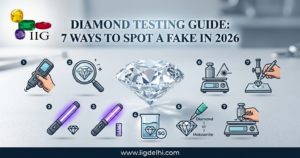
Diamond Testing Guide: 7 Ways to Spot a Fake in 2026
Diamonds have never been harder to verify by eye. Between lab-grown diamonds, high-quality moissanite, and advanced cubic zirconia, even seasoned jewelry buyers in 2026 struggle to tell a genuine stone from a convincing imitation. If you have ever held a diamond inherited, gifted, or purchased and quietly wondered, Is this actually real?, you are not alone. This guide breaks down seven reliable ways to test a diamond, explains what each test can (and cannot) prove, and shows you why professional gemological training is the only method that removes all doubt. Whether you are a jewelry buyer, a collector, or someone exploring a career in gems, understanding these tests is the first step toward real expertise the kind taught in a structured Gem Identification Course. Why Diamond Authentication Matters More in 2026 The diamond market has changed dramatically over the last few years. Lab-grown diamonds are now common in Indian and global jewelry markets, moissanite has improved to the point where it fools basic testers, and online diamond sales have made it easier than ever to buy a stone without ever seeing it in person first. A few realities every buyer should know in 2026: This is exactly why a growing number of jewelry professionals, collectors, and small business owners in India are enrolling in a formal Gem Identification Course rather than relying on guesswork. Diamond vs. Common Fakes: Quick Comparison Table Before testing a stone, it helps to know what you might actually be dealing with. Here is how a real diamond compares to the most common substitutes found in the Indian and global jewelry market. Property Real Diamond Cubic Zirconia (CZ) Moissanite White Sapphire Hardness (Mohs Scale) 10 (hardest known mineral) 8 – 8.5 9.25 9 Thermal Conductivity Extremely high Very low High (can fool testers) Low Sparkle Type Balanced white + colored flashes Excessive rainbow flashes Very strong rainbow flashes Duller, hazier sparkle Density Higher (sinks fast in water) Heavier per size, but low density index Slightly lower than diamond Lower than diamond Facet Edges Sharp, crisp Often slightly rounded Sharp Sharp Electrical Conductivity Does not conduct Does not conduct Conducts electricity Does not conduct Common Use Fine jewelry, engagement rings Costume & imitation jewelry Diamond alternative Natural gemstone, diamond look-alike This table alone explains why a single home test is never enough – several fakes share one or two diamond-like properties, but none share all of them. 7 Ways to Spot a Fake Diamond Below are the seven most practical and widely used methods for checking a diamond’s authenticity, ranked from simplest at-home checks to professional laboratory-grade testing. 1. The Fog Test Breathe lightly on the stone, the way you would fog up a mirror. A real diamond disperses heat so quickly that the fog clears in about a second. If the stone stays foggy for several seconds, it is likely an imitation such as cubic zirconia or glass. What it actually proves: Diamonds conduct heat extremely well, so they clear fog almost instantly. This test can rule out low-grade imitations quickly, but it cannot distinguish a diamond from moissanite, since moissanite also disperses heat fast. 2. The Water Test Drop the loose stone into a glass of water. Because diamonds are dense, a genuine stone sinks immediately. Many imitations, including glass and lower-density simulants, float or sink slowly. What it actually proves: This test only works on loose (unmounted) stones and is unreliable for smaller stones or heavier simulants like large cubic zirconia, which can sink too. It is a helpful first filter, not a final answer. 3. The Sparkle and Light Reflection Test Hold the stone under a bright light or near a window and observe how it reflects light. A well-cut diamond shows a balanced mix of white brilliance and small flashes of color (called “fire”). Fakes often throw excessive, overly colorful flashes or look flat and glassy. What it actually proves: Sparkle differences are real, but they require experience to judge accurately. Without comparing the stone to a known diamond side by side, most people misjudge this test – which is one of the core skills taught hands-on in a Gem Identification Course. 4. The Loupe and Facet Test Using a jeweler’s loupe or a 10x magnifying glass, examine the stone’s facet edges and internal characteristics. Diamonds are cut by skilled professionals and typically show sharp, crisp facet edges along with natural inclusions (tiny internal marks). Molded imitations often have rounded or slightly soft edges, and flawless stones with zero inclusions are more likely fakes than natural diamonds. What it actually proves: This is one of the more reliable at-home checks, but reading a loupe correctly takes training. An untrained eye frequently misreads natural inclusions as damage, or misses telltale mold marks entirely. 5. The Setting and Mounting Check Look at how the stone is set in its jewelry piece. Genuine diamonds are usually mounted in gold, white gold, or platinum, with a hallmark stamp (14K, 18K, PT950, etc.) stamped inside the band. Cheap imitations are frequently set in gold-plated or silver-toned base metal, and the craftsmanship around the setting is often noticeably lower quality. What it actually proves: This is circumstantial evidence, not proof. High-quality fakes can still be set in real gold, so this test should always be combined with others. 6. The UV (Ultraviolet) Light Test Place the stone under a UV lamp. Many natural diamonds emit a soft blue glow, known as fluorescence, under UV light. Absence of fluorescence does not mean a stone is fake, since a large share of natural diamonds show no fluorescence at all — but the presence of unusual colors (such as green or yellow glow) can indicate a simulant. What it actually proves: This test is inconclusive on its own, since fluorescence patterns vary widely among real diamonds. It works best as a supporting test, not a standalone verdict. 7. Professional Thermal and Electrical Conductivity Testing This is the gold standard among the seven methods. A jeweler or gemologist uses a calibrated … Continue reading Diamond Testing Guide: 7 Ways to Spot a Fake in 2026
